
This website may earn commissions from certain purchases via the Amazon Associates program at no cost to you.
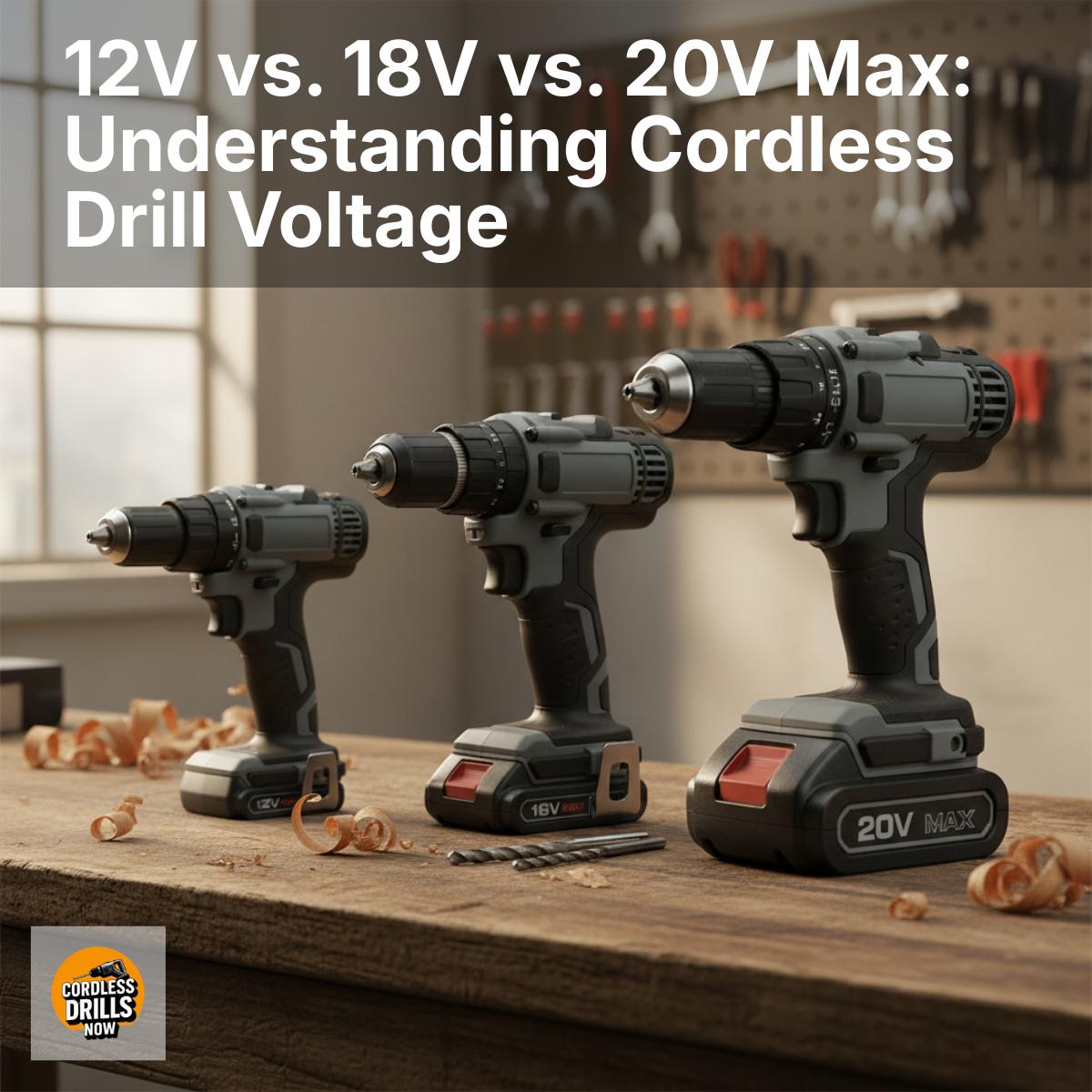
You’re standing in the tool aisle, looking at two drills that look almost identical. One is labeled “18V,” and the other says “20V Max.” The 20V is slightly more expensive, and logic suggests that higher voltage equals more power. But then you notice a 12V model nearby—half the size, remarkably light, and surprisingly professional-looking.
Is the 12V just a “toy” for light duty? Is the 20V actually 11% more powerful than the 18V?
The “Quick Truth” Summary:
- 18V and 20V Max are identical in power. They use the same battery cells. “20V Max” is a marketing term for the battery’s peak voltage at startup, while “18V” is the nominal operating voltage.
- 12V is not a “weak” tool. Modern brushless 12V tools can handle 80% of household and professional service tasks with half the weight.
- The choice isn’t about voltage; it’s about the “ecosystem.” Once you buy the battery, you’re locked into that brand’s platform.
The Marketing Myth: Why 20V Max and 18V Are the Same Thing
If you feel like you’re being tricked by tool brands, you aren’t entirely wrong. The debate between DeWalt 20V Max vs. 18V (used by Milwaukee, Makita, and Bosch) is one of the most successful marketing maneuvers in hardware history.
Nominal vs. Peak Voltage Explained
Every cordless drill battery is made up of individual lithium-ion cells. Each cell has a “nominal” voltage of 3.6V and a “peak” (fully charged) voltage of 4.0V.
- An 18V battery uses five cells: 5 cells x 3.6V = 18V (Nominal).
- A 20V Max battery uses the same five cells: 5 cells x 4.0V = 20V (Max).
When you pull the trigger, the battery provides a brief “surge” of 20 volts, but as soon as the tool begins working, it settles into a steady 18 volts. In Europe, the same DeWalt tools labeled “20V Max” in the U.S. are labeled “18V” to comply with stricter advertising laws.
Why Brand Ecosystems Matter More Than Voltage Labels
When you choose a voltage, you aren’t just choosing a motor; you are choosing a battery platform. If you buy a Milwaukee M18 drill, your batteries will work with their 18V chainsaws, vacuums, and impact wrenches. If you buy DeWalt 20V Max, you are committed to their yellow-and-black ecosystem. Don’t let a “20V” sticker sway you—look at the range of tools the brand offers in that battery line instead.
12V Drills: The Underestimated Powerhouse
For a long time, 12V tools were relegated to the “junk drawer.” They were weak, slow-charging, and felt like plastic toys. That changed with the advent of brushless motors and high-density lithium-ion cells.
Benefits: Weight, Ergonomics, and Tight Spaces
The primary advantage of a 12V system is the power-to-weight ratio. A 12V drill typically weighs 2 lbs less than its 18V counterpart. For a “Precision Pro”—like a cabinet maker or an electrician—that weight difference is the difference between a productive afternoon and a week of carpal tunnel symptoms.
What can a 12V drill actually do?
Don’t let the small footprint fool you. A high-quality 12V drill (like the Milwaukee M12 Fuel or Bosch 12V Max) can easily handle:
- Assembling flat-pack furniture.
- Hanging drywall or cabinetry.
- Driving 3-inch deck screws (though slower than an 18V).
- Running spade bits up to 1 inch for electrical wiring.
When to avoid 12V
If your project involves large hole saws (over 2 inches), long lag bolts or mixing thin-set mortar, a 12V motor will likely overheat or stall. It lacks the sustained “grunt” needed for high-resistance, high-torque applications.
18V/20V Drills: The Industry Standard for Heavy Lifting
If the 12V is a scalpel, the 18V/20V is a sledgehammer. This is the “primary tool” category designed for heavy construction and all-day endurance.
Performance: Torque, Run-time, and Capability
An 18V drill provides significantly more torque (twisting force). While a 12V drill might provide 350-400 in-lbs of torque, a high-end 18V drill can push 1,000+ in-lbs. Furthermore, because 18V batteries can hold more cells, the Amp-hours (Ah) are generally higher, meaning you can drive hundreds of more screws on a single charge.
Best Projects for 18V/20V
- Deck Building: Driving 4-inch structural screws into pressure-treated lumber.
- Framing: Building sheds, additions, or basement walls.
- Masonry: Drilling into concrete or brick using the “hammer drill” function.
- Auger Bits: Boring deep holes through thick timber.
The Trade-off: Weight Fatigue and Tool Footprint
The cost of that power is physical. Using an 18V drill overhead to install a ceiling fan or repetitive drywall work will lead to significant shoulder and wrist fatigue. Additionally, the bulky battery pack makes it difficult to reach screws inside cabinets or tight corners.
Side-by-Side Comparison: Which Voltage Wins?
| Feature | 12V System | 18V / 20V Max System |
|---|---|---|
| Avg. Weight | 2.0 – 2.5 lbs | 3.5 – 5.5 lbs |
| Max Torque | 300 – 450 in-lbs | 500 – 1,200 in-lbs |
| Best For | Accuracy, Portability, Service | Raw Power, Construction, Speed |
| Battery Cost | Lower ($30 – $60) | Higher ($80 – $150+) |
| Ideal User | Homeowners, HVAC, Finish Carps | General Contractors, Deck Builders |
How to Choose: A Decision Matrix Based on Your Project
Stop looking at the voltage and start looking at your “to-do” list.
“I’m a first-time homeowner with a small repair list.”
Recommendation: 12V.
You don’t need a heavy construction tool to hang pictures, fix a loose hinge, or assemble IKEA furniture. A 12V drill is easier to store in a kitchen drawer and much more approachable for a novice.
“I’m planning a DIY kitchen remodel or outdoor deck.”
Recommendation: 18V/20V.
Renovations require “punch.” You’ll be drilling through studs and driving heavy fasteners. The 18V/20V system provides the versatility to handle these high-torque tasks without the tool smoking or stalling.
“I’m a pro looking to save my wrists.”
Recommendation: High-end 12V (Brushless).
If you already own heavy gear, look into the “Pro-grade” 12V lines (like Milwaukee M12 Fuel or DeWalt 12V Xtreme). These tools are designed specifically for service technicians who value “weight-to-power” for overhead work and service calls.
Pro Tip from the Jobsite: If you are drilling 50+ holes overhead for conduit or lighting, the weight of an 18V drill will kill your productivity by 2:00 PM. Many pros carry an 18V impact for the “big stuff” but keep a 12V drill on their belt for 90% of the day’s tasks.
Battery Ecosystems: The “System Lock-in” Factor
The most important thing to remember is that 12V batteries will not work in 18V tools, and vice-versa (even within the same brand).
- Check the “Tool Roster”: Before buying, look at what else that battery powers. Does that brand make a 12V vacuum? A 12V tire inflator?
- Amp-Hours (Ah): Don’t just look at voltage. A 12V battery with 4.0Ah will often outlast an 18V battery with 1.5Ah on light tasks.
Conclusion: The “Sweet Spot” for Most Users
If you are a serious DIYer who wants one tool to do everything, the 18V/20V Max system is the safest bet. It has the ceiling of power you’ll need for that one time you have to drill into concrete or build a garden shed.
However, if you are a homeowner focused on indoor maintenance, or a specialized pro tired of hauling heavy bags, the 12V system is the smarter, more ergonomic choice.
Ignore the marketing labels. Whether it says 18V or 20V Max, you’re getting the same engine. Choose the tool that fits your hand and your project list, not the one with the biggest number on the box.