This website may earn commissions from certain purchases via the Amazon Associates program at no cost to you.
You’ve likely been there: You’re halfway through building a garden bed or hanging a heavy TV mount, and your cordless drill starts to scream. The motor smells like it’s burning, the bit slips out of the screw head for the tenth time—stripping the metal into a useless crater—and your wrist is throbbing from the “kickback.”
At this point, you see the “Combo Kits” at the hardware store and wonder: Is that stubby-looking tool next to the drill actually different, or is it just a marketing gimmick to get me to spend an extra $100?
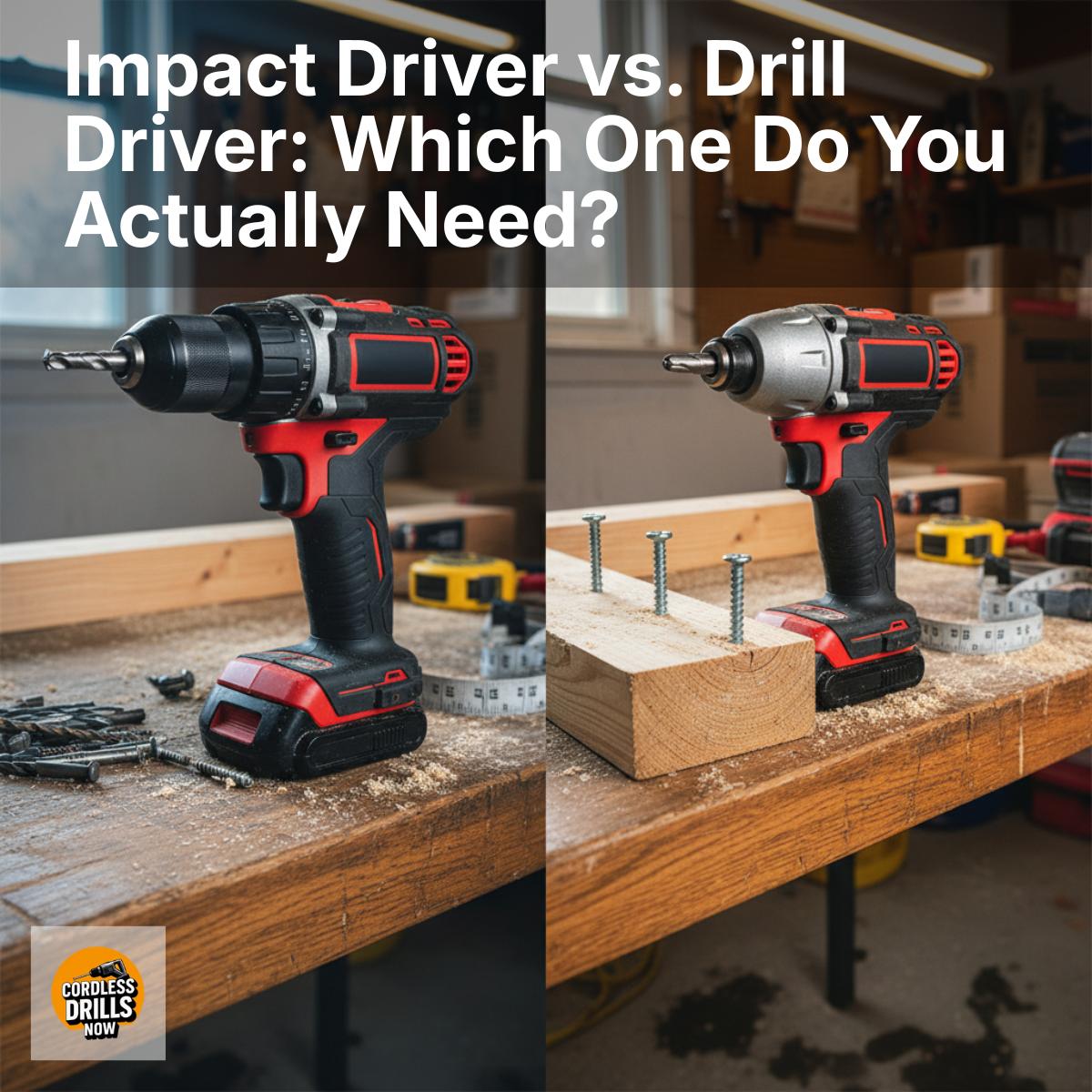
While they look like siblings, the drill driver and the impact driver have entirely different “brains” and mechanical souls. Understanding the difference is the secret to moving from a frustrated amateur to a confident DIYer.
The Core Difference: Constant Pressure vs. Rapid Hammers
To understand which tool you need, you have to understand how they deliver power. One is a marathon runner; the other is a heavyweight boxer.
How a Drill Driver Works (The Smooth Operator)
A standard drill driver applies constant rotational torque. When you pull the trigger, the chuck (the part that holds the bit) spins at a steady rate.
The standout feature of a drill is the adjustable clutch settings—that numbered ring near the tip. This allows you to “dial in” the torque. Once the screw hits a certain level of resistance, the drill stops spinning the bit and makes a clicking sound. This precision is vital because it prevents you from driving a screw straight through a piece of fragile drywall or snapping a small brass fastener.
How an Impact Driver Works (The Power Hitter)
An impact driver doesn’t just spin; it hammers. Inside the tool is a rotary hammer mechanism consisting of two metal “anvils” and a spring-loaded hammer.
Imagine you are trying to loosen a stuck lug nut on a car tire with a wrench. If you just pull on the wrench, it might not budge. But if you take a hammer and hit the handle of the wrench, that sharp thwack provides a massive burst of rotational force. That is exactly what an impact driver does—thousands of times per minute (measured in BPM, or Blows Per Minute).
Why Your Wrist Prefers the Impact Driver
Here is the “physics of failure” most people don’t realize: When a standard drill meets resistance, that energy has to go somewhere. If the screw won’t turn, the tool tries to turn your arm instead. This is called kickback, and it’s a leading cause of wrist strain.
Because an impact driver uses internal hammering to create torque, that energy is directed downward into the screw, not outward into your hand. You can often drive a massive 4-inch lag bolt with one hand using an impact driver, whereas a standard drill would require two hands and a lot of leaning weight to keep it from twisting out of your grip.
Project Face-Off: Which Tool Wins?
Choosing the right tool depends entirely on what you’re doing this Saturday morning.
Hanging Pictures and Assembling IKEA (Winner: Drill Driver)
For delicate tasks, the impact driver is “too much tool.” Its raw power will likely strip the soft particle board used in flat-pack furniture or snap the tiny screws used for picture hangers. The drill driver’s clutch allows you to set the power low for perfect precision.
Building Decks, Fences, and Garden Beds (Winner: Impact Driver)
If you are driving long 3-inch deck screws into pressure-treated lumber, the impact driver is non-negotiable. It prevents cam-out—the technical term for when the bit jumps out of the screw head—and drives the fastener significantly faster without the need for a pilot hole in most cases.
Hanging TV Mounts into Wall Studs (Winner: Impact Driver)
Lag bolts are thick, heavy-duty screws. A standard drill will often stall or overheat trying to force these into a solid wood stud. The “percussion” of the impact driver’s internal hammers makes these heavy-duty tasks feel effortless.
Drilling Large Holes in Wood or Metal (Winner: Drill Driver)
Impact drivers are for driving; drills are for drilling. The drill driver features a 1/2-inch keyless chuck that can accept round-shank bits of all sizes. If you’re using a spade bit to run a 1-inch hole for electrical wire or a hole saw for a new door handle, the constant, smooth rotation of a drill produces a much cleaner, more accurate hole.
Pro Tip from the Job Site:
“I spent the first three years of my career using a standard drill for everything. I thought impact drivers were just for ‘pros.’ The first time I used one to build a deck, I realized I’d been working twice as hard for no reason. My screws stopped stripping, and my elbow stopped hurting by 4:00 PM. Now, the drill stays in the bag unless I’m making a hole.” — Mark S., General Contractor
The “Hidden” Costs of Switching to an Impact Driver
Before you run out and buy an impact driver, you need to know that your current accessories might not work.
The Hex-Shank Requirement
Drills have a “chuck” that opens and closes to grip almost any bit. Impact drivers use a 1/4-inch hex chuck. It’s a quick-release sleeve that only accepts bits with a hexagonal base. If your current drill bits are smooth and round, they will not fit in an impact driver.
Why You Must Buy “Impact-Rated” Bits
This is a crucial safety warning. Standard screwdriver bits are made of hard, brittle steel. The “hammering” force of an impact driver will shatter a standard bit, often sending metal shards flying. You must purchase bits specifically labeled “Impact-Rated.” These are designed with a “torsion zone” that allows the bit to flex slightly under the stress of the hammer blows.
The Versatility Myth: Can One Tool Do It All?
Can I use an Impact Driver as a Drill?
Technically, yes. You can buy hex-shank drill bits. However, because an impact driver lacks a clutch and has a tiny bit of “wobble” in the hex chuck, it is not a precision tool. It’s fine for “rough-in” work, but don’t use it for fine cabinetry or anywhere a perfectly clean hole is required.
Can I use a Drill as an Impact Driver?
You can try, but you will face the “Cam-out” curse. Without the percussive force of the impact mechanism, you have to apply immense downward pressure to keep the bit seated in the screw. This leads to stripped screws, ruined workpieces, and physical exhaustion.
Buying Strategy: Should You Buy the Combo Kit?
For 90% of homeowners and DIYers, the Combo Kit is the best ROI. Manufacturers like DeWalt, Milwaukee, Makita, and Ryobi offer these kits because they know you need both.
- The Brand Ecosystem Trap: Remember that batteries are generally not interchangeable between brands. Once you buy a DeWalt drill, you are “locked in” to the DeWalt battery platform. Pick a brand that has other tools you might want later (like a leaf blower or a circular saw).
- When to Save Your Money: If you live in an apartment and your only “projects” are hanging the occasional mirror or tightening a loose cabinet door, a high-quality 12V or 18V Drill/Driver is all you need. You don’t need the specialized power of an impact driver for light-duty maintenance.
Final Verdict: The 30-Second Rule for Choosing
Still not sure which one to grab from the toolbox? Use this simple rule:
- Choose the Drill Driver if: You are making a hole (drilling), using a hole saw, or working with delicate materials like IKEA furniture or drywall.
- Choose the Impact Driver if: You are driving a screw longer than 2 inches, working with structural timber, or tight spaces where you can’t get two hands on the tool.
By using the right tool for the job, you’ll stop fighting your equipment and start actually enjoying your projects.